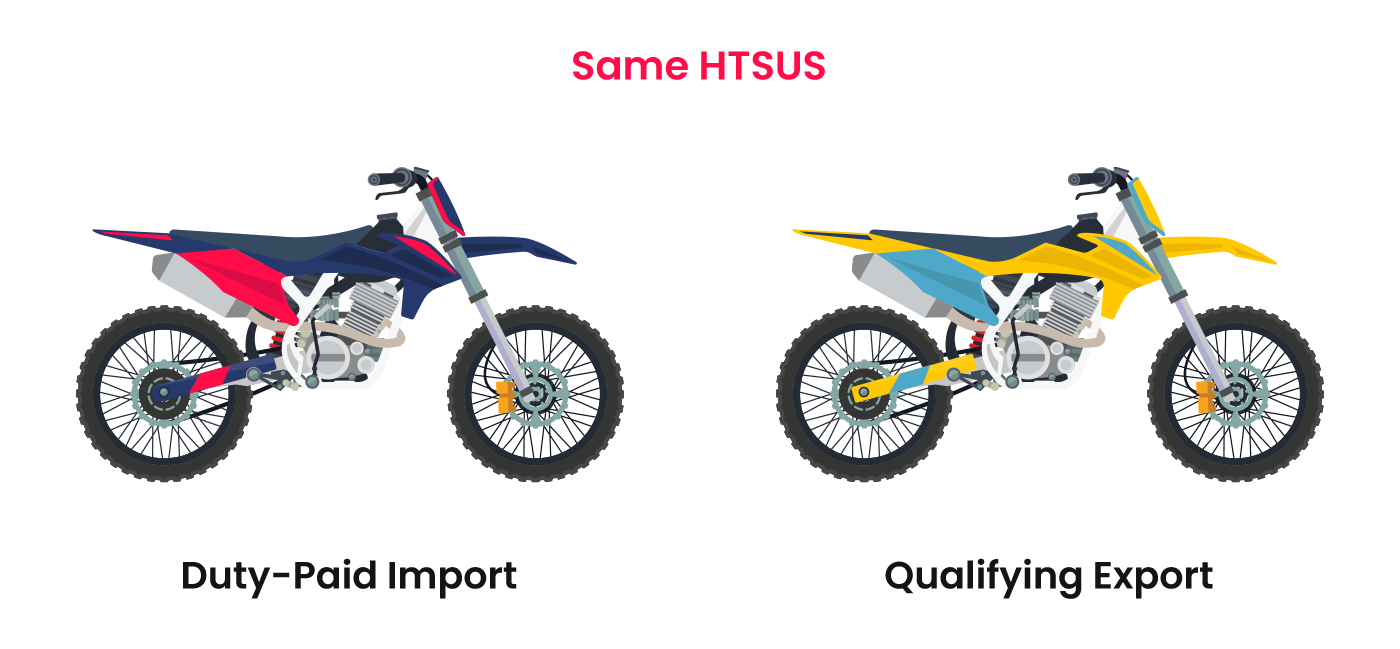
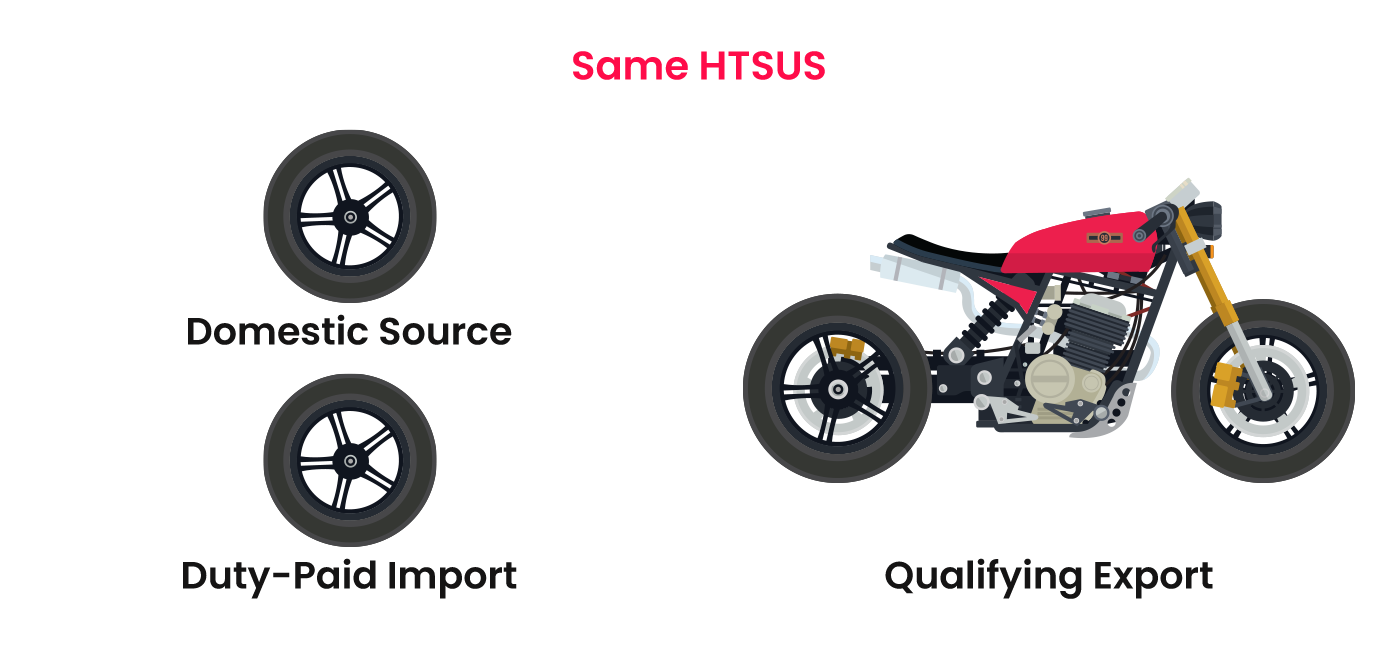
Duty-paid import
- HTSUS
- 8711.20.00
- HTSUS
- 8714.10.00
- HTSUS
- Same 8-digit HTS
- Origin
- Imported, duty paid
The substitution matching method allows for exports, regardless of their origin, to be substituted at the 8 or 10-digit Harmonized Tariff Schedule number against duty paid imports. Additionally, certain qualifications must be met dependent of the filing provision being used.
HTS-level substitution allows flexibility matching duty-paid imports to qualifying exports.
A different article qualifies, matched at the classification level
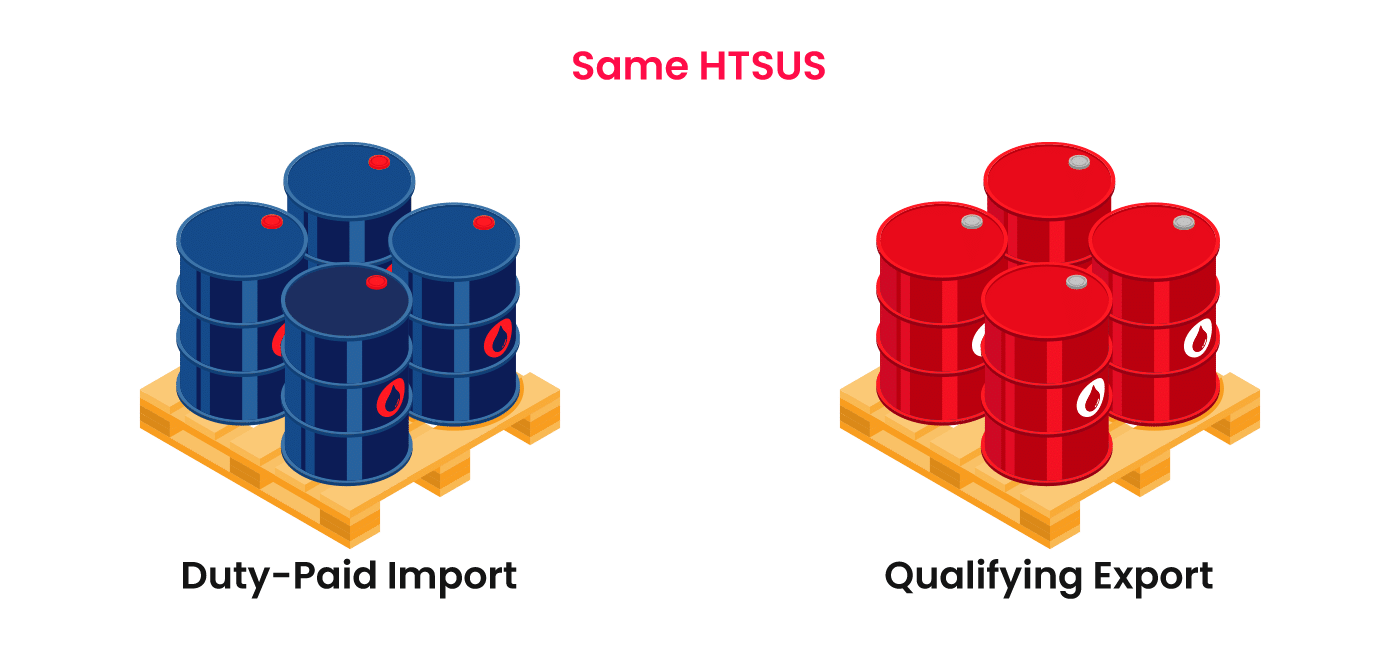
A different article qualifies, provided it shares the same classification.A component of the same classification qualifies, whatever its origin.The exported petroleum product qualifies whatever its origin, within 180 days of the import.
Modernized Drawback, 19 CFR Part 190. Read the full part at eCFR.
(a) General. Section 313(j)(2) of the Act, as amended (19 U.S.C. 1313(j)(2)), provides for drawback of duties, taxes, and fees paid on imported merchandise based on the export or destruction under CBP supervision of substituted merchandise (as defined in § 190.2, pursuant to 19 U.S.C. 1313(j)(2)), before the close of the 5-year period beginning on the date of importation of the imported merchandise and before the drawback claim is filed, and before such exportation or destruction the substituted merchandise is not used in the United States (see paragraph (e) of this section) and is in the possession of the party claiming drawback. The amount of duties, taxes, and fees eligible for drawback is determined by per unit averaging, as defined in 19 CFR 190.2, for any drawback claim based on 19 U.S.C. 1313(j)(2).
(1) Exportation. In the case of an article that is exported, subject to paragraph (b)(3) of this section, the total amount of drawback allowable will not exceed 99 percent of the lesser of:
(i) The amount of duties, taxes, and fees paid with respect to the imported merchandise; or
(ii) The amount of duties, taxes, and fees that would apply to the exported article if the exported article were imported.
(2) Destruction. In the case of an article that is destroyed, subject to paragraph (b)(3) of this section, the total amount of drawback allowable will not exceed 99 percent of the lesser of:
(i) The amount of duties, taxes, and fees paid with respect to the imported merchandise (after the value of the imported merchandise has been reduced by the value of materials recovered during destruction as provided in 19 U.S.C. 1313(x)); or
(ii) The amount of duties, taxes, and fees that would apply to the destroyed article if the destroyed article had been imported (after the value of the imported merchandise has been reduced by the value of materials recovered during destruction as provided in 19 U.S.C. 1313(x)).
(3) Federal excise tax. For purposes of drawback of internal revenue tax imposed under Chapters 32, 38 (with the exception of Subchapter A of Chapter 38), 51, and 52 of the Internal Revenue Code of 1986, as amended (IRC), drawback granted on the export or destruction of substituted merchandise will be limited to the amount of taxes paid (and not returned by refund, credit, or drawback) on the substituted merchandise.
Requests for binding rulings on the classification of imported, substituted, or exported merchandise may be submitted to CBP pursuant to the procedures set forth in part 177.
(1) Alternative substitution standard. In addition to the 8-digit HTSUS substitution standard in § 190.2, drawback of duties, taxes, and fees, paid on imported wine as defined in § 190.2 may be allowable under 19 U.S.C. 1313(j)(2) with respect to wine if the imported wine and the exported wine are of the same color and the price variation between the imported wine and the exported wine does not exceed 50 percent.
(2) Allowable refund. For any drawback claim for wine (as defined in § 190.2) based on 19 U.S.C. 1313(j)(2), the total amount of drawback allowable will not exceed 99 percent of the duties, taxes, and fees paid with respect to the imported merchandise, without regard to the limitations in paragraph (b)(1) or (b)(2) of this section.
(3) Required certification. When the basis for substitution for wine drawback claims under 19 U.S.C. 1313(j)(2) is the alternative substitution standard rule set forth in (d)(1), claims under this subpart may be paid and liquidated if:
(i) The claimant specifies on the drawback entry that the basis for substitution is the alternative substitution standard for wine; and
(ii) The claimant provides a certification, as part of the complete claim (see 190.51(a)), stating that:
(A) The imported wine and the exported wine are a Class 1 grape wine (as defined in 27 CFR 4.21(a)(1)) of the same color (i.e., red, white, or rosé);
(B) The imported wine and the exported wine are table wines (as defined in 27 CFR 4.21(a)(2)) and the alcoholic content does not exceed 14 percent by volume; and
(C) The price variation between the imported wine and the exported wine does not exceed 50 percent.
The performing of any operation or combination of operations, not amounting to manufacture or production as provided for in 19 U.S.C. 1313(j)(3)(B), on the substituted merchandise is not a use of that merchandise for purposes of this section.
(1) General rule. Upon compliance with the requirements of this section and under 19 U.S.C. 1313(s), a drawback successor as defined in paragraph (f)(2) of this section may designate either of the following as the basis for drawback on merchandise possessed by the successor after the date of succession:
(i) Imported merchandise which the predecessor, before the date of succession, imported; or
(ii) Imported and/or substituted merchandise that was transferred to the predecessor from the person who imported and paid duty on the imported merchandise.
(2) Drawback successor. A “drawback successor” is an entity to which another entity (predecessor) has transferred, by written agreement, merger, or corporate resolution:
(i) All or substantially all of the rights, privileges, immunities, powers, duties, and liabilities of the predecessor; or
(ii) The assets and other business interests of a division, plant, or other business unit of such predecessor, but only if in such transfer the value of the transferred realty, personalty, and intangibles (other than drawback rights, inchoate or otherwise) exceeds the value of all transferred drawback rights, inchoate or otherwise.
(3) Certifications and required evidence.
(i) Records of predecessor. The predecessor or successor must certify that the successor is in possession of the predecessor’s records which are necessary to establish the right to drawback under the law and regulations with respect to the imported and/or substituted merchandise.
(ii) Merchandise not otherwise designated. The predecessor or successor must certify that the predecessor has not designated and will not designate, nor enable any other person to designate, the imported and/or substituted merchandise as the basis for drawback.
(iii) Value of transferred property. In instances in which assets and other business interests of a division, plant, or other business unit of a predecessor are transferred, the predecessor or successor must specify, and maintain supporting records to establish, the value of the drawback rights and the value of all other transferred property.
(iv) Review by CBP. The written agreement, merger, or corporate resolution, provided for in paragraph (f)(2) of this section, and the records and evidence provided for in paragraph (f)(3)(i) through (iii) of this section, must be retained by the appropriate party(s) for 3 years from the date of liquidation of the related claim and are subject to review by CBP upon request.
(1)(i) Substitution standard. If imported, duty-paid merchandise or merchandise classifiable under the same 8-digit HTSUS subheading number as the imported merchandise is used in the manufacture or production of articles within a period not to exceed 5 years from the date of importation of such imported merchandise, then upon the exportation, or destruction under CBP supervision, of any such articles, without their having been used in the United States prior to such exportation or destruction, drawback is provided for in section 313(b) of the Act, as amended (19 U.S.C. 1313(b)). Drawback is allowable even though none of the imported, duty-paid merchandise may actually have been used in the manufacture or production of the exported or destroyed articles. The amount of duties, taxes, and fees eligible for drawback is determined by per unit averaging, as defined in § 190.2, for any drawback claim based on 19 U.S.C. 1313(b).
(ii) Allowable refund. (A) Exportation. In the case of an article that is exported, the amount of drawback allowable will not exceed 99 percent of the lesser of:
(1) The amount of duties, taxes, and fees paid with respect to the imported merchandise; or
(2) The amount of duties, taxes, and fees that would apply to the substituted merchandise if the substituted merchandise were imported.
(B) Destruction. In the case of an article that is destroyed, the amount of drawback allowable will not exceed 99 percent of the lesser of:
(1) The amount of duties, taxes, and fees paid with respect to the imported merchandise (after the value of the imported merchandise has been reduced by the value of materials recovered during destruction as provided in 19 U.S.C. 1313(x)); or
(2) The amount of duties, taxes, and fees that would apply to the substituted merchandise if the substituted merchandise were imported (after the value of the imported merchandise has been reduced by the value of materials recovered during destruction as provided in 19 U.S.C. 1313(x)).
(C) Federal excise tax. For purposes of drawback of internal revenue tax imposed under Chapters 32, 38 (with the exception of Subchapter A of Chapter 38), 51, and 52 of the Internal Revenue Code of 1986, as amended (IRC), drawback granted on the export or destruction of substituted merchandise will be limited to the amount of taxes paid (and not returned by refund, credit, or drawback) on the substituted merchandise.
(2) Special rule for sought chemical elements. (i) Substitution standard. A sought chemical element, as defined in § 190.2, may be considered imported merchandise, or merchandise classifiable under the same 8-digit HTSUS subheading number as such imported merchandise, used in the manufacture or production of an article as described in paragraph (a)(1)(i) of this section, and it may be substituted for source material containing that sought chemical element, without regard to whether the sought chemical element and the source material are classifiable under the same 8-digit HTSUS subheading number, and apportioned quantitatively, as appropriate (see § 190.26(b)(4)).
(ii) Allowable refund. The amount of drawback allowable will be determined in accordance with paragraph (a)(1)(ii) of this section. The value of the substituted source material must be determined based on the quantity of the sought chemical element present in the source material, as calculated per § 190.26(b)(4).
(b) Use by same manufacturer or producer at different factory. Duty-paid merchandise or drawback products used at one factory of a manufacturer or producer within 5 years after the date on which the material was imported may be designated as the basis for drawback on articles manufactured or produced in accordance with these regulations at other factories of the same manufacturer or producer.
(c) Designation. A manufacturer or producer may designate any eligible imported merchandise or drawback product which it has used in manufacture or production.
(1) General rule. Upon compliance with the requirements in this section and under 19 U.S.C. 1313(s), a drawback successor as defined in paragraph (d)(2) of this section may designate merchandise or drawback product used by a predecessor before the date of succession as the basis for drawback on articles manufactured or produced by the successor after the date of succession.
(2) Drawback successor. A “drawback successor” is a manufacturer or producer to whom another entity (predecessor) has transferred, by written agreement, merger, or corporate resolution:
(i) All or substantially all of the rights, privileges, immunities, powers, duties, and liabilities of the predecessor; or
(ii) The assets and other business interests of a division, plant, or other business unit of such predecessor, but only if in such transfer the value of the transferred realty, personalty, and intangibles (other than drawback rights, inchoate or otherwise) exceeds the value of all transferred drawback rights, inchoate or otherwise.
(3) Certifications and required evidence.
(i) Records of predecessor. The predecessor or successor must certify that the successor is in possession of the predecessor’s records which are necessary to establish the right to drawback under the law and regulations with respect to the merchandise or drawback product.
(ii) Merchandise not otherwise designated. The predecessor or successor must certify that the predecessor has not designated and will not designate, nor enable any other person to designate, such merchandise or product as the basis for drawback.
(iii) Value of transferred property. In instances in which assets and other business interests of a division, plant, or other business unit of a predecessor are transferred, the predecessor or successor must specify, and maintain supporting records to establish, the value of the drawback rights and the value of all other transferred property.
(iv) Review by CBP. The written agreement, merger, or corporate resolution, provided for in paragraph (d)(2) of this section, and the records and evidence provided for in paragraph (d)(3)(i) through (iii) of this section, must be retained by the appropriate party(s) for 3 years from the date of liquidation of the related claim and are subject to review by CBP upon request.
(1) General. Where two or more products are produced concurrently in a substitution manufacturing operation, drawback will be distributed to each product in accordance with its relative value (see § 190.2) at the time of separation.
(2) Claims covering a manufacturing period. Where the claim covers a manufacturing period rather than a manufacturing lot, the entire period covered by the claim is the time of separation of the products and the value per unit of product is the market value for the period (as provided for in the definition of relative value in § 190.2). Manufacturing periods in excess of one month may not be used without specific approval of CBP.
(3) Recordkeeping. Records must be maintained showing the relative value of each product at the time of separation.
When the exported article which is the basis for a drawback claim under 19 U.S.C. 1313(p) is petroleum derivatives which were manufactured or produced in the United States and qualify for drawback under the manufacturing drawback law (19 U.S.C. 1313(a) or (b)), the requirements for drawback are as follows:
(a) Merchandise. The merchandise which is the basis for drawback under 19 U.S.C. 1313(p) must:
(1) Have been manufactured or produced as described in 19 U.S.C. 1313(a) or (b) from crude petroleum or a petroleum derivative; and
(2) Be a “qualified article” as defined in § 190.172(a);
(b) Exported article. The exported article on which drawback is claimed must be an “exported article” as defined in § 190.172(c);
(c) Exporter. The exporter of the exported article must have either:
(1) Manufactured or produced the qualified article in at least the quantity of the exported article; or
(2) Purchased or exchanged (directly or indirectly) from a manufacturer or producer described in 19 U.S.C. 1313(a) or (b) the qualified article in at least the quantity of the exported article;
(d) Manufacture in specific facility. The qualified article must have been manufactured or produced in a specific petroleum refinery or production facility which must be identified;
(e) Time of export. The exported article must be exported either:
(1) During the period provided for in the manufacturer’s or producer’s specific manufacturing drawback ruling (see § 190.8) in which the qualified article is manufactured or produced; or
(2) Within 180 days after the close of the period in which the qualified article is manufactured or produced; and
(f) Amount of drawback. The amount of drawback payable may not exceed the amount of drawback which would be attributable to the article manufactured or produced under 19 U.S.C. 1313(a) or (b) which serves as the basis for drawback.
Where this provision sits inside the wider duty drawback framework.
Start with the fundamentals.
How the drawback lifecycle works, the four statutory filing provisions, and what is eligible for refund.
Back to drawback explainedThe other matching method.
Direct identification uses lot number or serial number tracking, or an accepted accounting method, to match an export back to its exact importation.
Learn about direct identificationFind out what you can recover.
A licensed drawback specialist reviews your import and export activity at no cost and no obligation.
Start your assessmentThe optimization engine.
How Apollo evaluates every compliant import to export combination and solves for the highest recovery, rather than matching in sequence.
Learn more about ApolloSubstitution drawback lets you match an export to a duty-paid import that is not the same physical merchandise, provided both share the same 8-digit HTSUS classification. It applies under 19 USC 1313(j)(2), 1313(b) and 1313(p).
Since TFTEA, substitution is based on the 8-digit HTSUS subheading. Where the 8-digit description begins with the word other, the 10-digit statistical reporting number is used instead.
No. Under 19 USC 1313(j)(2) and 1313(p), the export cannot be to a USMCA country or a US Territory. Where that is the case, direct identification matching must be used instead.