Duty-paid import
- Importer
- Domestic vendor
- Supplier
- Then
- Sold domestically

Third party drawback allows import rights to be transferred, or export rights to be waived, when a commercial relationship exists but the importer and exporter of record are different entities.
Incoterms matter in duty drawback for imported duty-paid merchandise and exports.
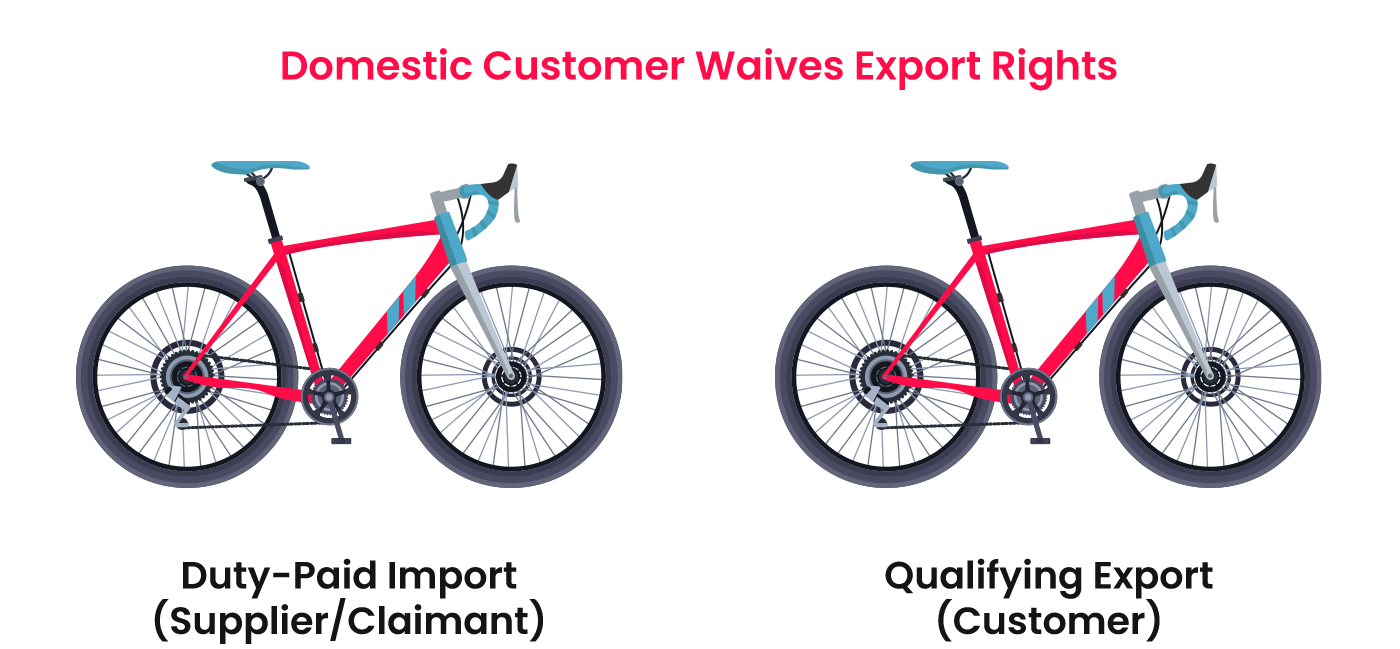
The customer waives export rights to the supplier
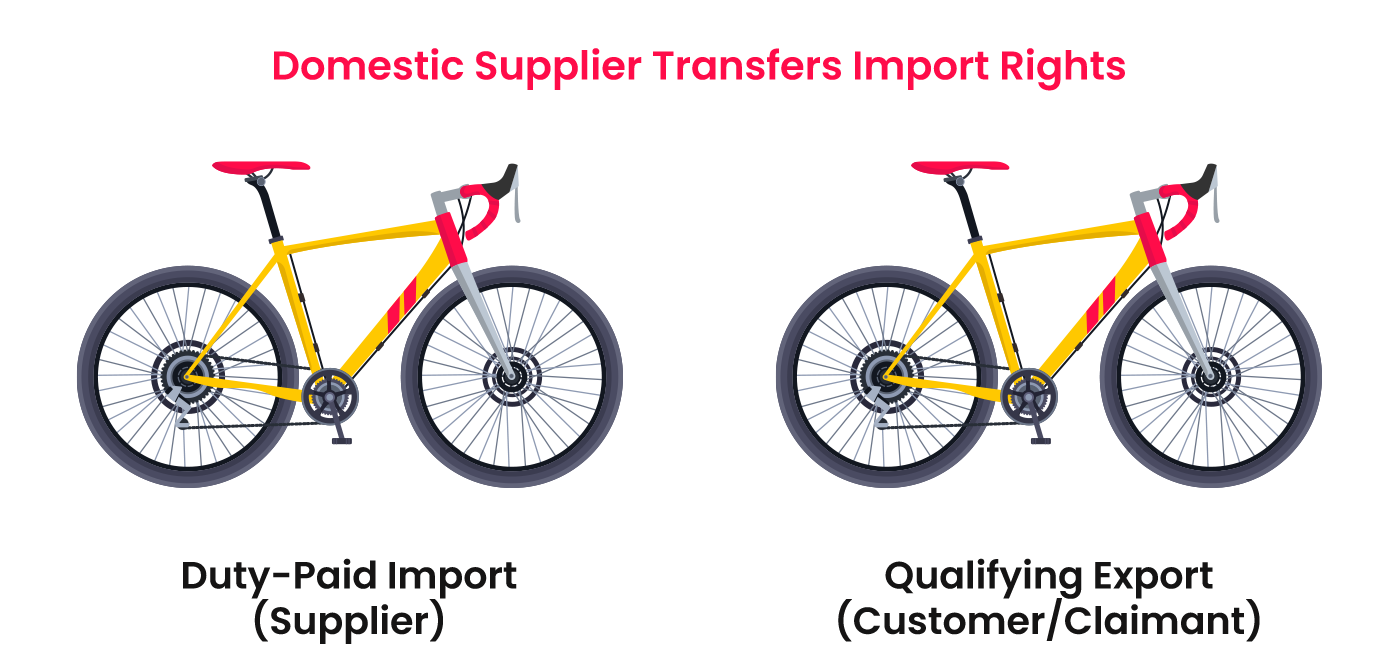
The supplier transfers import rights to the customer
The customer exports, but with their participation the export rights are waived to the supplier, who claims against their duty-paid imports.The supplier imported duty paid, but with their participation the import rights transfer to the customer, who claims against their own qualifying exports.
Modernized Drawback, 19 CFR Part 190. Read the full part at eCFR.
(1) A party may transfer drawback eligible merchandise or articles to another party, provided that the transferring party:
(i) Imports and pays duties, taxes, and/or fees on such imported merchandise;
(ii) Receives such imported merchandise;
(iii) In the case of 19 U.S.C. 1313(j)(2), receives such imported merchandise, substituted merchandise, or any combination of such imported and substituted merchandise; or
(iv) Receives an article manufactured or produced under 19 U.S.C. 1313(a) and/or (b).
(2) The transferring party must maintain records that:
(i) Document the transfer of that merchandise or article;
(ii) Identify such merchandise or article as being that to which a potential right to drawback exists; and
(iii) Assign such right to the transferee (see § 190.82).
The records that support the transfer must include the following information:
(1) The party to whom the merchandise or articles are delivered;
(2) Date of physical delivery;
(3) Import entry number and entry line item number;
(4) Quantity delivered and, for substitution claims, total quantity attributable to the relevant import entry line item number;
(5) Total duties, taxes, and fees paid on, or attributable to, the delivered merchandise, and, for substitution claims, total duties, taxes, and fees paid on, or attributable to, the relevant import entry line item number;
(6) Date of importation;
(7) Port where import entry filed;
(8) Person from whom received;
(9) Description of the merchandise delivered;
(10) The 10-digit HTSUS classification for the designated imported merchandise (such HTSUS number must be from the entry summary line item and other entry documentation for the merchandise); and
(11) If the merchandise transferred is substituted for the designated imported merchandise under 19 U.S.C. 1313(j)(2), the 10-digit HTSUS classification of the substituted merchandise (as if it had been imported).
(c) Line item designation for partial transfers of merchandise. Regardless of any agreement between the transferor and the transferee, the method used for the first filed claim relating to merchandise reported on that entry summary line item will be the exclusive basis for the calculation of refunds (either using per unit averaging or not) for any subsequent claims for any other merchandise reported on that same entry summary line item. See § 190.51(a)(3).
(d) Retention period. The records listed in paragraph (b) of this section must be retained by the issuing party for 3 years from the date of liquidation of the related claim or longer period if required by law (see 19 U.S.C. 1508(c)(3)).
(e) Submission to CBP. If the records required under paragraph (b) of this section or additional records requested by CBP are not provided by the claimant upon request by CBP, the part of the drawback claim dependent on those records will be denied.
(f) Warehouse transfer and withdrawals. The person in whose name merchandise is withdrawn from a bonded warehouse will be considered the importer for drawback purposes. No records are required to document prior transfers of merchandise while in a bonded warehouse.
Where this provision sits inside the wider duty drawback framework.
Start with the fundamentals.
How the drawback lifecycle works, the four statutory filing provisions, and what is eligible for refund.
Back to drawback explainedWhen there is no commercial relationship.
Drawback trading uses a third-party trading company to align unaffiliated companies with excess imports and exports under 19 U.S.C. 1313(p).
Learn about drawback tradingFind out what you can recover.
A licensed drawback specialist reviews your import and export activity at no cost and no obligation.
Start your assessmentThe optimization engine.
How Apollo evaluates every compliant import to export combination and solves for the highest recovery, rather than matching in sequence.
Learn more about ApolloThird party drawback allows drawback rights to be transferred or waived when the importer of record and the exporter of record are not the same company but have a commercial relationship. It is also referred to as multiple party drawback.
When a commercial relationship exists but the importer of record and the exporter of record are different entities. The importer can transfer the duty-paid imports to the exporter, or retain claimant rights by securing a waiver of drawback rights from the exporter.
A transfer record containing the 11 required data elements. Records are retained for three years from the liquidation of the related claim.
A 10-digit HTSUS classification is required for the designated merchandise.
The importer of record (IOR) is the party identified by its EIN on the CBP Form 7501 entry summary. The exporter of record (EOR) is the party shown as the shipper on the bill of lading. The EOR holds the first right to claim drawback, which is exactly why third party drawback matters when the importer and exporter are different companies.