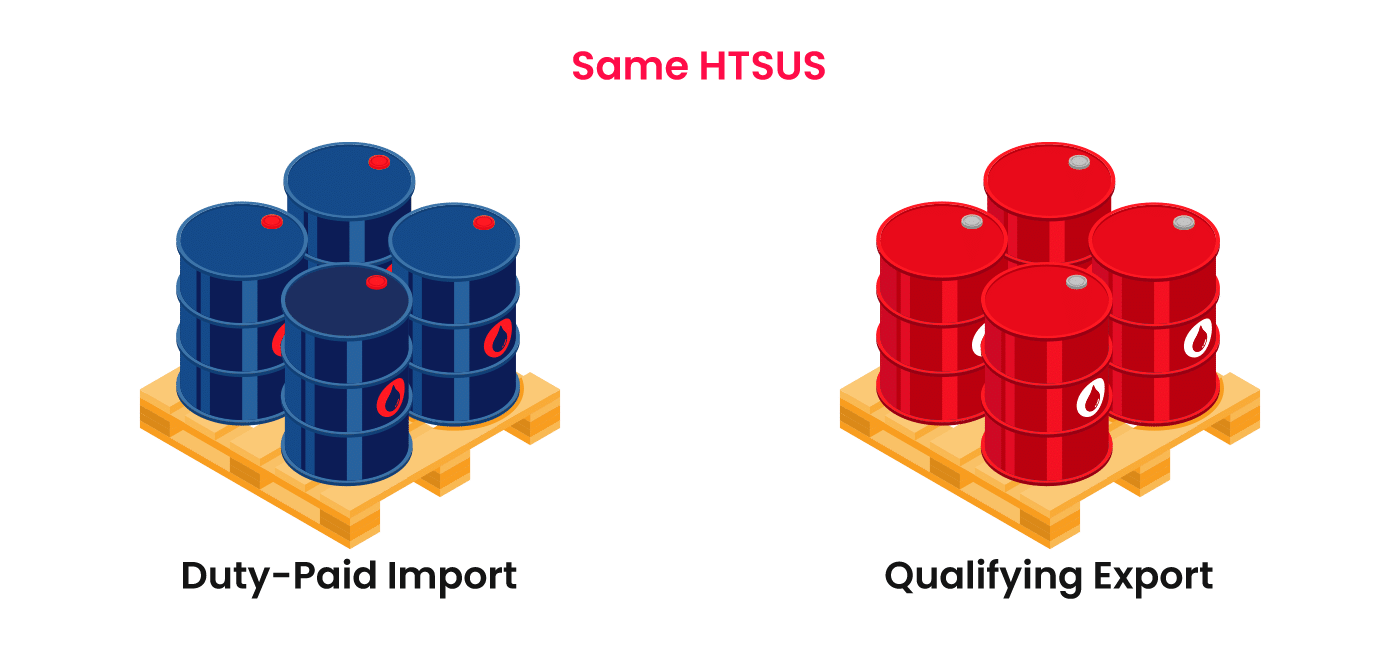
Duty-paid import
- HTSUS
- Same 8-digit HTS
- Origin
- Imported, duty paid

The petrochemical drawback filing provision allows for the refund of duties on the export of domestically produced petrochemicals in exchange (substituted) for chemicals imported into the United States, so long as they both fall within the same 8-digit HTSUS classification.
Petrochemical drawback allows you to substitute exported petrochemicals at the 8-digit HTSUS.
The import and the export must fall within 180 days of each other
The exported petroleum product qualifies whatever its origin, provided it shares the same 8-digit classification as the duty-paid import and the two fall within 180 days of each other.
Petrochemical drawback applies two separate classification tests. The first decides whether an article is eligible at all. The second decides whether an export can be matched to an import.
The statute and the regulation list the eligible classifications directly. Most are stated at the four-digit heading level, with a handful of narrower subheadings called out. Everything falling under a listed heading is within scope.
This is where the eight-digit level applies. An export is of the same kind and quality as the qualified article if it is referred to under the same 8-digit HTSUS classification, or if it is commercially interchangeable with it.
If two articles shared the same 8-digit classification on January 1, 2000, they are still treated as sharing it today, even if either has since been reclassified.
Modernized Drawback, 19 CFR Part 190. Read the full part at eCFR.
Section 313(p) of the Act, as amended (19 U.S.C. 1313(p)), provides for drawback for duties, taxes, and fees paid on qualified articles (see definition below) which consist of either petroleum derivatives that are imported, duty-paid, and qualified for drawback under the unused merchandise drawback law (19 U.S.C. 1313(j)(1)), or petroleum derivatives that are manufactured or produced in the United States, and qualified for drawback under the manufacturing drawback law (19 U.S.C. 1313(a) or (b)).
Drawback may be granted under 19 U.S.C. 1313(p):
(1) In cases where there is no manufacture, upon exportation of the imported article, an article of the same kind and quality, or any combination thereof; or
(2) In cases where there is a manufacture or production, upon exportation of the manufactured or produced article, an article of the same kind and quality, or any combination thereof.
For drawback of finished petroleum derivatives pursuant to section 1313(p), the claimant is required to calculate the total amount of drawback due, for purposes of § 190.51(b), which will not exceed 99 percent of the allowable duties, taxes, and fees, subject to the following:
(1) Per unit averaging calculation. The amount of duties, taxes, and fees eligible for drawback is determined by per unit averaging, as defined in § 190.2, for any drawback claim based on 19 U.S.C. 1313(p) pursuant to the standards set forth in § 190.172(b) and without respect to the limitations set forth in subparagraphs (B) and (C) of 19 U.S.C. 1313(l).
(2) Limitations. The amount of duties, taxes, and fees eligible for drawback is not subject to the limitations set out in 19 U.S.C. 1313(p)(4) for unused merchandise claims (no manufacture) and manufacturing claims (see 190.173(e) and 190.174(f)).
(3) Federal excise tax. For purposes of drawback of internal revenue tax imposed under Chapters 32 and 38 (with the exception of Subchapter A of Chapter 38) of the Internal Revenue Code of 1986, as amended (IRC), drawback granted on the export of substituted merchandise will be limited to the amount of taxes paid (and not returned by refund, credit, or drawback) on the substituted merchandise.
Where this provision sits inside the wider duty drawback framework.
Start with the fundamentals.
How the drawback lifecycle works, the four statutory filing provisions, and what is eligible for refund.
Back to drawback explainedApplicable only under 1313(p).
Drawback trading uses a third-party trading company to align unaffiliated companies with excess imports and exports under the same 8-digit HTSUS classification.
Learn about drawback tradingFind out what you can recover.
A licensed drawback specialist reviews your import and export activity at no cost and no obligation.
Start your assessmentThe optimization engine.
How Apollo evaluates every compliant import to export combination and solves for the highest recovery, rather than matching in sequence.
Learn more about ApolloPetrochemical drawback is the refund of import duties on qualifying chemicals under 19 U.S.C. 1313(p). Imported chemicals are matched to exported petrochemicals that share the same 8-digit HTSUS classification, and the exported product qualifies regardless of its origin.
Chemicals and petrochemicals where the imported product and the exported product fall within the same 8-digit HTSUS classification.
The imported chemical and the exported petrochemical must fall within 180 days of each other.
No. Petrochemical drawback is a substitution provision. A domestically produced petrochemical export qualifies regardless of origin, provided it shares the same 8-digit HTSUS classification as the imported chemical.